














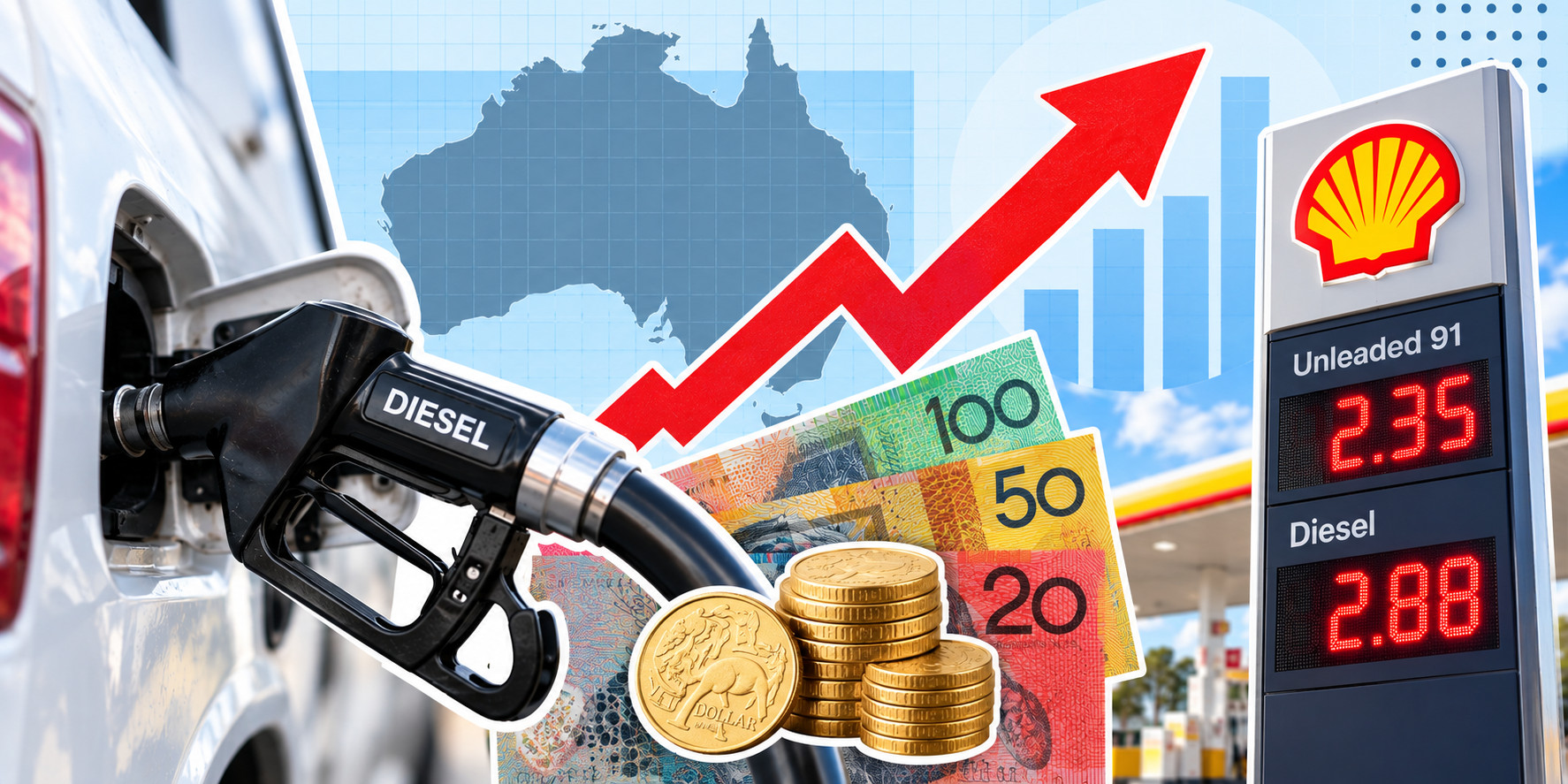
Anyone filling a diesel tank lately has probably done a bit of a double take at the bowser. Diesel has become particularly expensive in Australia in 2026, with the latest ACCC monitoring showing average retail diesel prices increased again in the week to 24 September. The regulator says the rise has been influenced by high international refined fuel prices as the conflict in the Middle East continues.
And while high fuel prices are hardly new to Australian motorists, diesel matters particularly to businesses. Tradies, couriers, transport operators, farmers and companies running vehicle fleets can burn through hundreds or thousands of litres every month, meaning even relatively small movements in the price per litre can quickly turn into a sizeable operating cost.
So why is diesel so expensive right now?
How expensive is diesel in Australia right now?
Wholesale prices give us some idea of just how elevated the market has become.
Australian Institute of Petroleum data shows Sydney’s average diesel Terminal Gate Price was 278.6 cents per litre on 22 September 2026. By Monday 28 September it had eased to 269.2c/L, but that was still an extraordinarily high wholesale price before transport and retail operating costs are considered.
It’s also important to distinguish these wholesale figures from the number motorists actually see on the service station board. Terminal Gate Prices are an indicator of wholesale diesel prices and don’t include costs such as transporting the fuel to individual service stations or other retail operating costs.
Prices also vary significantly between locations, so there isn’t one single “Australian diesel price” that applies everywhere.
What we can say is that diesel remains expensive, and several factors have come together to keep it that way.
1. International diesel prices are high
The first thing to understand is that Australia doesn’t determine the underlying price of diesel in isolation.
Australian retail diesel prices are heavily influenced by an international benchmark known as Singapore Gasoil 10 ppm. When that benchmark rises, Australian wholesale prices generally follow, before eventually flowing through to prices at the pump.
The ACCC says international benchmark prices have the greatest influence on Australian fuel prices, with movements generally taking around two weeks to work their way through the supply chain in Australian cities and longer in regional areas.
That means an international price shock doesn’t necessarily appear on the service station board overnight. Equally, a drop in international prices doesn’t guarantee an immediate drop at the bowser.
2. The Middle East conflict is affecting fuel markets
One of the biggest factors in 2026 has been the ongoing conflict in the Middle East.
The ACCC began publishing weekly fuel monitoring updates after the conflict began in late February, tracking movements in crude oil, international refined fuel benchmarks and Australian wholesale and retail prices.
In its 24 September update, the regulator said average petrol and diesel prices had increased across monitored locations during the previous week, influenced by high international refined fuel benchmark prices as the conflict continued.
Australia is therefore feeling the effects of events happening thousands of kilometres away.
Oil and refined fuels are internationally traded commodities, so disruption or concern about future supply can affect global prices, which then feeds into Australia’s fuel market.
3. The temporary fuel excise relief has ended
There’s another reason the numbers at the pump have become more painful.
Earlier this year, the Australian Government temporarily reduced fuel excise on petrol and diesel. The initial relief was subsequently extended, with a 16-cent-per-litre reduction applying from 1 July until 2 August 2026.
That temporary relief has now ended.
Fuel excise forms part of the wholesale price of petrol and diesel, so restoring it increased the tax component built into the price of fuel. Fuel excise is ordinarily indexed twice a year in line with inflation.
It doesn’t explain the entire increase in diesel prices, but it does mean businesses are no longer receiving the temporary tax relief that helped soften high fuel costs earlier in the year.
4. The Australian dollar matters, too
There’s another factor that’s easy to overlook: the exchange rate.
International fuel benchmarks are priced in US dollars. Australian companies, naturally, are buying in Australian dollars.
That means movements in the AUD/USD exchange rate can change how much imported fuel effectively costs here.
A weaker Australian dollar can make international fuel more expensive in Australian-dollar terms, while a stronger dollar can provide some relief. But the relationship isn’t as simple as “Australian dollar up, diesel price down”, because international benchmark prices and other costs can move at the same time.
It’s one reason predicting where diesel prices go next is so difficult.
Why can diesel cost so much more than petrol?
Petrol and diesel may both come from crude oil, but they aren’t priced against the same international refined fuel benchmark.
Australian petrol prices are influenced by Singapore Mogas 95, while diesel is linked to Singapore Gasoil 10 ppm. Each fuel has its own global supply and demand conditions.
Diesel also has uses well beyond passenger vehicles. It’s heavily used in freight, agriculture, mining, construction, industry and remote power generation. So diesel prices don’t necessarily move in lockstep with unleaded petrol.
There’s another difference Australian motorists may notice.
Diesel doesn’t have the same price cycle as petrol
If you’ve ever watched petrol jump dramatically one week before gradually falling again, you’ve seen Australia’s petrol price cycles at work.
Those cycles occur in Sydney, Melbourne, Brisbane, Adelaide and Perth. Diesel doesn’t follow those price cycles.
So waiting for the “cheap day” in the petrol cycle isn’t really a strategy for a business buying diesel.
Instead, diesel prices tend to respond more directly to international prices, wholesale costs and competition between retailers.
What do high diesel prices mean for Australian businesses?
For a business, it’s useful to think about fuel increases in terms of litres rather than individual fill-ups.
Say a small fleet uses 2,000 litres of diesel per month.
A 10c/L increase adds approximately $200 a month to its fuel bill. A 20c/L increase means another $400, while a 50c/L increase translates to roughly $1,000 in additional monthly fuel costs.
For a transport or logistics operation consuming tens of thousands of litres, those increases become considerably larger.
And businesses don’t necessarily have the luxury of simply driving less. A plumber still needs to reach jobs, a courier still needs to deliver parcels and a trucking company still needs to move freight.
That makes controlling the price paid for each litre particularly important.
What can businesses do about high diesel prices?
Unfortunately, no fuel card, app or clever trick can make international diesel prices disappear.
But businesses can reduce how much unnecessary margin they’re paying on top.
One of the simplest steps is comparing prices before filling up. The ACCC specifically recommends fuel-price apps and websites, noting that motorists can save money by finding lower-priced service stations in their area
For businesses, it can also be worth reviewing:
- where vehicles are regularly being filled
- whether drivers are choosing conveniently located but consistently expensive stations
- how many litres the fleet consumes each month
- unnecessary idling and inefficient routes
- tyre pressures and vehicle maintenance
- whether a fuel card discount actually beats available pump prices
- fuel card fees and transaction charges
- whether the business can negotiate better pricing as its fuel volume grows.
The goal isn’t necessarily to chase the cheapest service station across town and burn fuel getting there. It’s to identify where meaningful savings can be made without making fleet operations less efficient.
Can a fuel card help when diesel prices are high?
Yes, although this is where it’s important to look beyond the headline discount.
Some Australian fuel cards provide cents-per-litre discounts, while others offer access to negotiated pricing or discounts at particular service station networks. They can also make it easier for businesses to track fuel expenditure and control what employees purchase.
When diesel is expensive, even a relatively small discount can add up. At 2,000 litres per month:
| Diesel discount | Approx. monthly saving | Approx. annual saving |
|---|---|---|
| 2c/L | $40 | $480 |
| 4c/L | $80 | $960 |
| 6c/L | $120 | $1,440 |
| 8c/L | $160 | $1,920 |
| 10c/L | $200 | $2,400 |
Those figures are illustrative and assume the discount applies to every litre purchased throughout the period. They don’t account for card fees, promotional limits or differences in pump prices.
Saving 8c/L at a station that’s 15c/L more expensive than another nearby retailer isn’t automatically a good deal. Likewise, a card with a large introductory discount may become considerably less attractive when the promotion ends.
Businesses should compare the actual cost of the fuel after discounts and fees, rather than treating the advertised cents-per-litre saving as the only number that matters.
Will diesel prices come back down?
There are simply too many moving parts to say exactly where diesel prices go from here.
International refined diesel prices, crude oil markets, geopolitical events, exchange rates, taxes, freight costs and local competition can all influence what Australian businesses ultimately pay.
There can also be a lag between movements overseas and what appears at Australian service stations. The ACCC says international benchmark movements can take around two weeks to flow through Australian city supply chains and longer in regional areas.
For now, the ACCC continues to publish weekly monitoring reports as the Middle East conflict affects global fuel markets. Its latest update shows diesel prices remain under pressure from elevated international refined fuel prices.
For businesses that can’t simply park the fleet until prices improve, the practical response is less about trying to predict the market and more about controlling the things they actually can: where they fill up, how efficiently vehicles are being used, what fees they’re paying and whether their current fuel card is genuinely reducing their cost per litre.
The best fuel card deals for tradies and diesel vehicles right now
With diesel prices this high, the discount attached to a fuel card can make a noticeable difference, particularly if you’re running a diesel ute, van or several work vehicles.
There are also some stronger-than-usual fuel card promotions available to Australian businesses right now. As of late September 2026, these include:
| Fuel card | Current offer | Worth knowing |
|---|---|---|
| FleetCard | Up to 10c/L off eligible petrol and diesel for the first 3 months | Applies to eligible Shell purchases and is capped at 2,000L. Apply by 16 October 2026. |
| AmpolCard | 9c/L off for 12 months + up to 200,000 Everyday Rewards points, or 7c/L off for 18 months | Eligible new customers must apply by 15 November 2026. |
| BP Plus | 8c/L off for 8 months + triple Qantas Points | Includes eligible diesel. Offer ends 30 November 2026. |
| Shell Card | 6c/L off for 12 months + no card fees for 12 months | Current offer also includes 12 months of AGA Roadside Assistance. |
FleetCard currently has the largest headline diesel discount of these offers at up to 10c/L, but the promotion only applies to eligible fuel purchased at Shell during the first three months and is capped at 2,000 litres per account. That puts the maximum value of the promotional fuel discount at around $200.
AmpolCard’s current promotion isn’t as high per litre, but it runs for considerably longer. Eligible businesses can choose 9c/L off for 12 months plus up to 200,000 bonus Everyday Rewards points, or 7c/L off for 18 months, with applications open until 15 November
BP Plus is another one worth comparing for diesel vehicles. New eligible customers can currently receive 8c/L off eligible fuels, including diesel, for the first eight months, along with triple Qantas Points. Applications for that promotion close on 30 November 2026.
Shell Card’s current offer provides 6c/L off fuel and no card fees for the first 12 months, along with 12 months of AGA Roadside Assistance.
So, which one makes sense for a tradie?
Don’t automatically go for whichever card advertises the biggest number.
If you’re running one diesel ute and only using a few hundred litres a month, fees, nearby service stations and the length of the discount could matter more than getting another cent or two off each litre. If you’re operating several diesel vehicles, however, those per-litre savings can become much more significant.
Think about where you already fill up, how many litres of diesel you’re buying each month and whether you’d actually use the card’s participating network. A discount isn’t much of a saving if you’re regularly driving out of your way to get it.
See if your business qualifies for a fuel card
With diesel prices putting more pressure on business running costs, a fuel card could help you better manage what you’re spending at the pump. Use our Fuel Card Eligibility Checker to see if your business could qualify and explore the fuel card options available to you.